Context: In the past, concerts were a lot harder to get access to than they are now, and therefore the photographs being taken didn't have to be up close and personal because it was hard for the audience to get a good view without paying a fortune.
Jay Blakesberg is a photographer who started out by taking his fathers Pentax camera to gigs in the 1970's.
He spent several years on the road with a group of Grateful Dead fans and took pictures of them; this experience then led to the opportunity of becoming the bands' official photographer.

http://potd.pdnonline.com/2013/08/21650/gratefuldead1/

https://walnutst.com/cart/products.php?cat=44&page=1&limit=28&display=mosaic
Jill Fermanovsky is a photographer who has specialised in documenting rock musicians; who initially began as an official photographer for the rainbow theatre in London, after a two week photography course. She has photographed artists such as Pink Floyd, Blondie, Bob Dylan, and Oasis.
 https://www.modernrocksgallery.com/bands-n-s/floyd-gilmour-furmanovsky
https://www.modernrocksgallery.com/bands-n-s/pink-floyd-rock-photographer-jill-furmanovsky
Presently, most artists will be assigned their own photographer by their record label, or will evolve as a band with the same photographer from the start.
Dean Sherwood, who currently photographs The Vamps full time, started out photographing them and shooting their videos for free as a favour to their manager (his friend). He currently uses a Sony ILCE-7RM2 for onstage photos and uses a Fujifilm X-T2 for offstage photos. He photographs The Vamps as well as their label signings The Tide and New Hope Club

https://www.flickr.com/photos/itsdeansherwood/31583958735/in/datetaken/

https://www.flickr.com/photos/itsdeansherwood/24616188969/in/album-72157664020168520/
Dean heavily uses the lights that he has on location, and empathises those in post production.
Elliott Ingham currently photographs pop punk bands State Champs and Speak Low If You Speak Love as well as photographing other bands such as Neck Deep, in between touring with State Champs.

https://www.instagram.com/p/BRoRY8ChRue/?taken-by=elliottxingham&hl=en

https://www.instagram.com/p/BR55jdfBwf4/?taken-by=elliottxingham&hl=en
Elliott uses blue presets in post production.
The main difference between the old concert pictures and the new is that the old pictures are all black and white, whereas the new are colour. This is both to do with the fact that to develop the film into colour would be more expensive, but also it will have been a lot harder to work with the lights on stage with old technology, especially when the pictures were not close up. There are a lot more restraints within music photography now. Whilst in the beginning of Blakebergs' concert photography career; the rules on cameras being brought into music venues were a lot more lenient, but nowadays venues and/ or artist management are a lot more strict about cameras, and usually only allow camera phones or cameras without a detachable lens to be brought into the event.
In the second part of this assignment I will be comparing documentary photography; specifically that of the war genre.
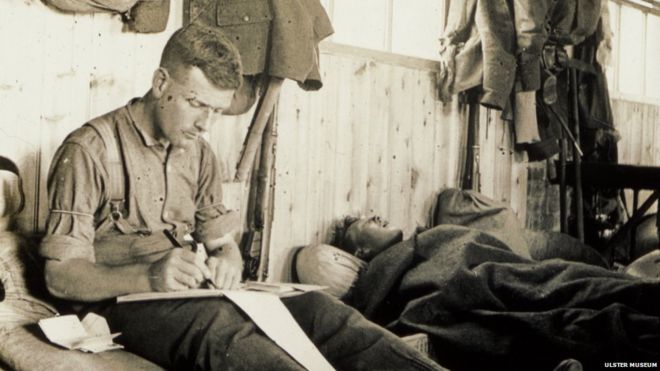
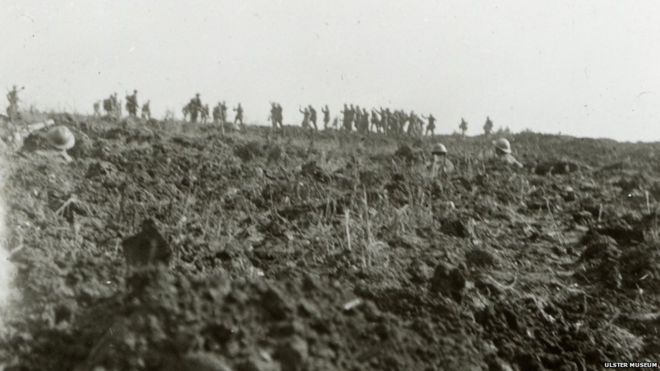
George Hackney was an aspiring photographer in Belfast and took his camera with him when he was sent to fight in 1915 (First World War). Unofficial photography was illegal, however the pictures survived the wars as did he.

'Photograph taken at Randalstown Camp, County Antrim 1915.' https://ichef.bbci.co.uk/news/660/media/images/78981000/jpg/_78981237_7444596-high-.jpg
It is said that this picture shows his friend writing a letter home/ writing in a diary whilst his other friend is sleeping.

'Photograph taken during the Battle of the Somme'- Shows German soldiers surrendering as an opposing devision advances towards them. https://ichef-1.bbci.co.uk/news/660/media/images/78991000/jpg/_78991366_7444685-high-.jpg
As a comparison to this, Mahmoud Al- Basha is a Syrian photographer that has taken pictures of the damage caused by the Syrian war.

'The dolls in a normal world represent the life .... the joy ... in Syria represent death'. http://www.motherjones.com/files/bashadolls.jpg

'In a normal country used to transport building materials ... #Syria is used to carry the dead and wounded'. http://www.motherjones.com/files/basha1.jpg
The differences between these two photographers and their images are that Hackney had to keep his camera well hidden, and therefore did not get close to the action with his camera, rather seemed to prefer shots of fellow soldiers 'to send to their families if they died' it is believed. Al- Basha however seems more likely to go into the action areas to spread awareness of what is happening in Syria on social media- as seen by the hashtags used. The captions are what he posted on twitter; which clearly shows a difference in time as there was no social media in Hackney's times.
For the third part of this assignment I will be looking at fashion photographers from the 60's compared to fashion photographers today.
Helmut Newton is an American photographer who had a contract with British Vogue and thus landed jobs with Playboy and Harper's bazaar. His images were black and white and the subjects were high contrast compared to the background. He shot with a 35mm Canon; preferring to use the flash on the camera rather than lighting equipment. He was known to balance on the line between pornography and fashion.

https://www.google.co.uk/url?sa=i&rct=j&q=&esrc=s&source=images&cd=&cad=rja&uact=8&ved=0ahUKEwjz07Gr0Z3UAhXKQBQKHVy_D6kQjRwIBw&url=http%3A%2F%2Fwww.dailymail.co.uk%2Ffemail%2Farticle-3333555%2FHelmut-Newton-s-incredible-snaps-featuring-Jerry-Hall-display.html&psig=AFQjCNGmifXRv-Cay1v08Pr0EfGILA7Onw&ust=1496440475875248
Sebastian Kim is a modern fashion photographer who has shot for a variety of top clients including Calvin Klein and H&M, and has had his work appear in most of the worlds editions of Vogue. The first camera he used was a Nikon F3. His work has the common theme of the models faces being partially covered/ models not looking at the camera. This appears to be incognito and not very posed; which makes the models appear more natural in the shots.

http://zero1magazine.com/article/sebastian-kim/picture-23-3/
The similarities are that both the artists use black and white in the examples; with the differences being that the first example film was naturally black and white in the past, and the second example was probably colour edited to be black and white in post production.



No comments:
Post a Comment